Resources · Buyer knowledge
Every buyer of a security gate eventually gets asked the same questions by a committee, a client or an auditor: what does it actually detect, why did that person pass through without alarming, and is it safe. This page explains the physics in plain language — no mystique, no exaggeration — so you can answer them.
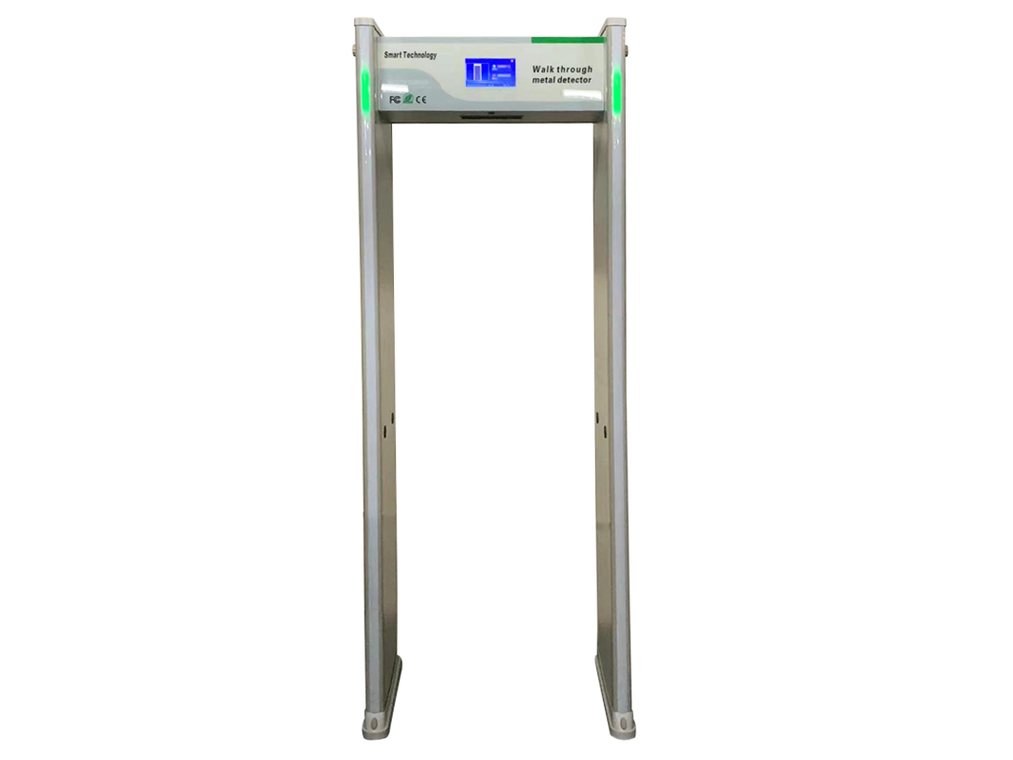
A transmit field, a receive circuit, and metal that gets in the way.
A walk-through metal detector is two Coil sets facing each other: a transmitter that creates a continuous low-intensity electromagnetic field between the panels, and receiver circuits that watch that field. Metal entering the field induces small eddy currents in the object, and those eddy currents distort the field in a characteristic way. When the disturbance crosses the threshold the electronics have been tuned to, the gate alarms.
That is also why tuning matters. Turn the sensitivity up far enough and the gate alarms on a belt buckle, a watch or a handful of coins — the physics cannot tell a weapon from a keyring, only 'metal of this size and type, here'. A well-run checkpoint is not the one with maximum sensitivity; it is the one whose sensitivity matches the prohibited-items policy and whose alarm rate can actually be resolved by the officers on the floor.
Multi-zone gates divide the field into vertical zones and report where the disturbance happened: the LED pillar lamps light the zone at waist height, or knee height, or shoulder height. The officer with the handheld detector starts at the lit zone instead of sweeping the whole person twice — that is where the seconds are saved.
One paddle, one field, one unambiguous signal.
A handheld detector puts the transmitter and receiver in a single paddle-sized unit. The detection face creates a field a few centimetres deep; sweeping it at 10–30 mm over clothing, bags or parcels covers the surface systematically. When metal disturbs the field, the unit responds with an audio tone, an LED, a vibration — or all three, depending on the model and the setting.
Sensitivity on a handheld is a dial, not a magic number. At optimum tuning the unit detects a handgun tens of centimetres away and a razor blade at a few centimetres; at low-sensitivity mode it ignores coins, keys and pins entirely and responds only to larger metal. This is a feature, not a compromise: most checkpoints want fewer, more meaningful alarms, and the low-sensitivity switch delivers exactly that without retuning the unit.
Batteries decide the shift. Handhelds run on a single 9 V battery for a full working day, and the quality of the alarm — a strong, stable tone — degrades gradually rather than suddenly as the battery empties. Units with a power indicator make this visible before it becomes a problem.
The honest list — the same list our engineers use when a customer says 'the gate missed something'.
| Factor | Effect on the result |
|---|---|
| Object size and material | Large ferrous objects are the easy case; small, thin or lightly conductive objects need higher sensitivity or closer sweep distance. |
| Sweep distance | Field strength falls off with distance. A handheld 30 mm from the surface finds far more than one waved 150 mm away. |
| Sweep speed | A fast pass can miss small objects. Systematic, overlapping sweeps find them. |
| Tuning | Sensitivity set to the policy, not to the maximum, keeps the alarm rate resolvable. |
| Environment | Large metal structures, moving machinery and nearby electrical equipment can influence the field; the gate position should respect the siting guidance in the manual. |
| Operator discipline | The zone lamps say where to look; the officer decides how the alarm is resolved. Equipment does not replace the procedure. |
The field strength of a walk-through detector is low, and the technology has been used at entrances worldwide for decades. People with implanted electronic devices follow their physician's advice and their organisation's screening policy; where policy allows, the standard alternative is a manual check with a handheld detector kept at a distance, or a physical search by an officer.
Either the object was below the tuned threshold, the sensitivity was set for a policy that permits it, or the object is not detectable by this technology at that setting. Metal detection is one layer; bag X-ray, procedures and trained staff are the others.
At high sensitivity, yes. This is exactly why multi-zone gates have per-zone tuning and handhelds have a low-sensitivity mode: the checkpoint defines which metal matters and tunes for that.
Metal detection senses the presence and location of metal; it cannot see inside a bag. X-ray screening images the contents of bags and parcels, showing shapes, densities and materials. At a normal checkpoint the two work side by side: the gate for people, the scanner for what they carry.
Tell us the country of installation and the intended use, and we will send the full technical catalogue and pricing.
Contact: Brandon, Sales Manager
Email: deal@topsaful.com
Tel / WhatsApp: +86 156 1616 8054
We usually reply within one business day.