Model · Walk-through metal detector
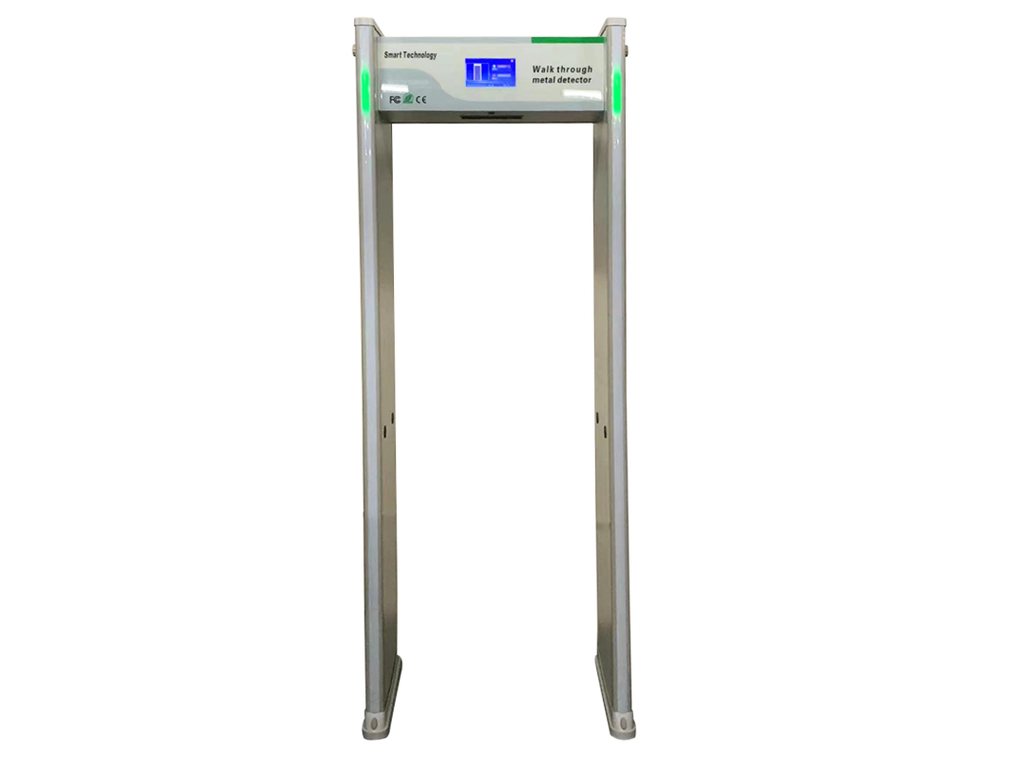
A networked 33-zone personnel screening gate with continuous detection areas and no blind spots, a 7.1-inch touchscreen, 2000 sensitivity levels per zone, and central management over LAN or cloud — including email reporting of alarm data to security management.
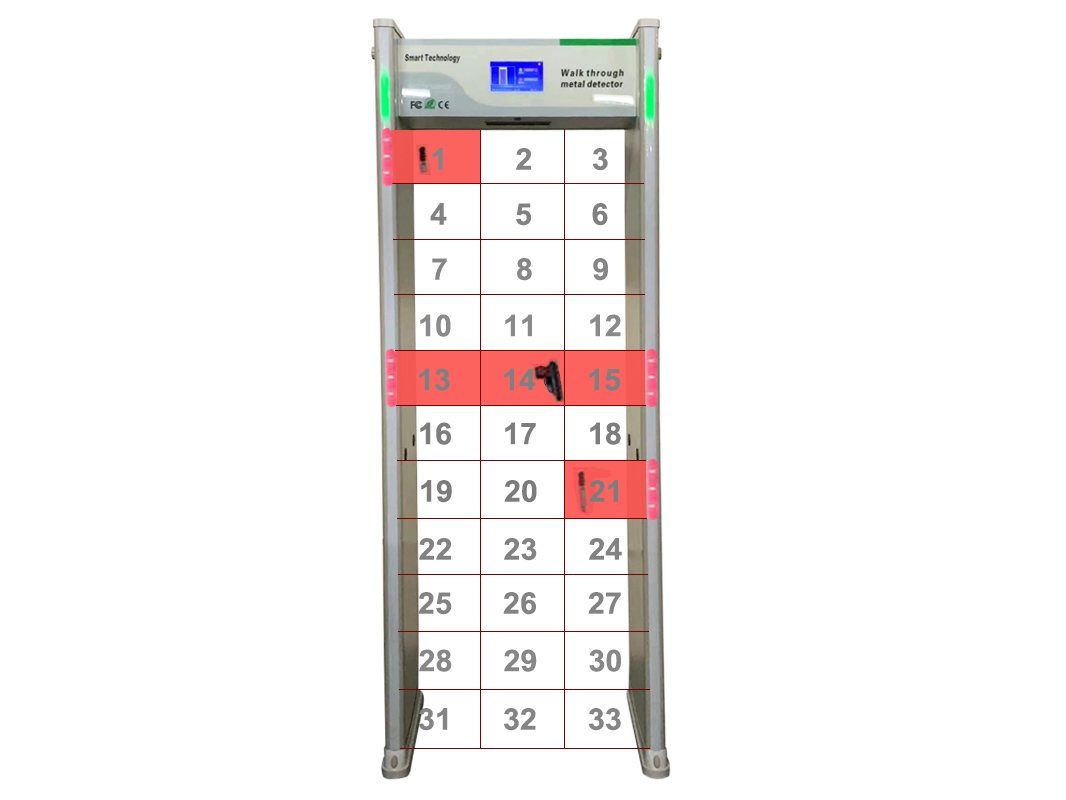
It locates the zone, not just the person.
The TS-WD33D is a pulsed-wave metal detection gate with digital phase shifting and correlation detection. Instead of alarming as a whole, it locates: the panel indicates the zone where the object is carried, so an officer knows where to look before the person has stopped walking. Sensitivity is adjustable in 2000 steps per zone, and a dedicated foot-zone adjustment handles the most common false-alarm source in practice — footwear and floor structures.
The unit is designed as an eight continuous detection area gate with no blind spots, operated from a 7.1-inch high-definition touchscreen, with a remote control option for sites that prefer it. Alarm indication is audible and visual, with two high-brightness alarm lamps indicating the position of a prohibited item, plus alphanumeric display, zone display and a low-battery indication.
The TS-WD33D is the networked model: gates report online status, alarm counts and alarm rates to a cloud server or local area network, security managers can receive email summaries, and detection parameters can be changed across every terminal in one action rather than gate by gate. An infrared counter counts people and alarms in both directions, and an EMC monitoring function makes it straightforward to check a site for electromagnetic interference before and after installation.
From the model datasheet, as supplied for procurement and site planning.
| Detection technology | Pulse wave with digital phase shifting, correlation detection |
|---|---|
| Detection zones | 8 continuous detection areas, no blind spots |
| Sensitivity | 2000 levels per program; detects a paperclip-sized metal item |
| Zone sensitivity | Adjustable 0 to 2000 per zone, no blind spot or dead area across the gate |
| Programs | More than 30 built-in programs for different security levels |
| Calibration | Automatic or manual |
| Interference suppression | Digital filtering in the signal processor; user-selectable working frequencies; gates may stand 30 cm apart |
| Alarm | Sound and light, two high-brightness alarm lamps indicating the position of the item; power-outage alarm; optional large external alarm |
| Display | Alphanumeric and zone display with rear red / green indicator lights |
| Self-diagnosis | Advanced self-test function that reports fault status |
| Counter | Infrared bidirectional counter for pass and alarm counts |
| Power supply | AC 100 – 260 V |
|---|---|
| Frequency | 40 – 65 Hz, wide range with automatic adaptation |
| Power consumption | 67.5 W (13.5 V, 5 A DC) |
| Protection rating | IP 55 (IEC 60529), excluding the external power supply |
| Working temperature | −10 °C to 55 °C |
| Humidity | 0 – 95%, non-condensing |
| Passage size | 2020 × 720 × 600 mm |
|---|---|
| Overall dimensions | 2220 × 840 × 710 mm |
| Net weight | 65 kg |
| Gross weight | 80 kg |
| Shipping volume | 0.5 m³ |
| Packing configuration | Control unit (crossbeam and electronics) 1 set; panel case (transmit panel and receive panel) 1 set |
| Central management | Cloud server or LAN, wired or one-to-many wireless bridge; real-time data classification, aggregation and display |
|---|---|
| Data notification | Equipment online status, alarm conditions, alarm rate and daily summaries, by email or push notification |
| Remote configuration | Terminal parameters configured from the platform and applied to all terminals in one action, or individually |
| Optional: backup power | 13.5 V DC battery supply, 2 – 8 hours |
| Optional: access control | Linkage to turnstiles and card reader systems |
| Optional: radiation alarm | Detection of radioactive material including X-ray and gamma sources |
| Optional: temperature screening | Thermal camera or infrared temperature measurement module |
The functions that decide whether a checkpoint stays orderly at peak.
Entrances where the officer has to find the object, not just hear an alarm.
Staff, contractor and guest gates with foot-zone tuning for dress shoes and boots.
Fast alarm resolution at the arrival peak, with silent handheld follow-up.
Gates standing as close as 30 cm apart with automatic frequency selection for multi-lane sites.
Consistent procedure at the staff door, with alarm statistics recorded for the facility.
Fewer zones suit low-traffic entrances where an alarm simply means a secondary check. More zones help where officers must locate an object quickly, where false alarms are frequent, or where several gates operate in parallel. The TS-WD33D offers 33 zones with 8 continuous detection areas for sites at the higher end of that range.
Reinforced footwear, steel-toe boots and heavy belts are the usual causes, and they are exactly what foot-zone sensitivity adjustment is for. Send us the footwear and uniform specification and we will advise on settings before installation.
The TS-WD33D allows gates 30 cm apart, and each unit selects its own working frequency automatically. That combination is what makes a multi-lane entrance practical without hand-tuning every gate on site.
Yes. Gates connect over wired Ethernet or a one-to-many wireless bridge to a cloud server or local area network for real-time status, aggregated alarm data and remote parameter changes, with email notification to security management.
Walk-through metal detectors use a pulsed magnetic field and emit no ionising radiation. The TS-WD33D is designed as a personnel screening gate for general use; if your site has specific regulatory requirements, tell us and we will confirm what documentation we can supply.
A flat, vibration-free floor, a power outlet within reach, and clearance from fixed metal structures. The gate assembles on site from the control unit and two panels and needs no civil works. Send a site photo or floor plan and we will advise on spacing before you order.
Tell us the country of installation and the intended use, and we will send the full technical catalogue and pricing.
Contact: Brandon, Sales Manager
Email: deal@topsaful.com
Tel / WhatsApp: +86 156 1616 8054
We usually reply within one business day.